





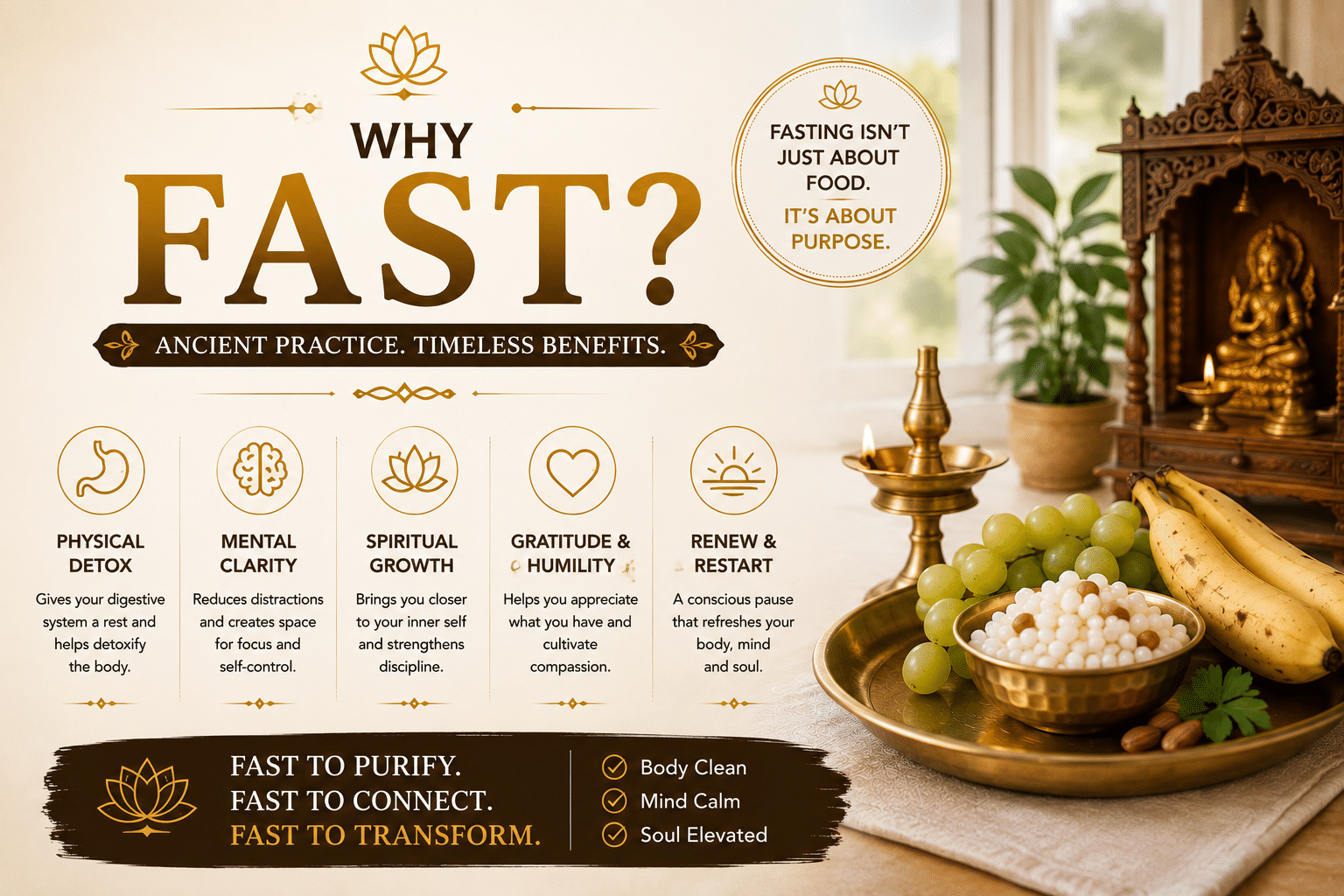
WHY Do We Fast? Understanding the Ancient Indian Why Tradition
Have you ever wondered why we fast?
In India, fasting is not simply about skipping meals. For millions of people, fasting—or vrat—is a familiar part of religious and cultural life. People may fast during Ekadashi, Navratri, Maha Shivratri, Janmashtami and other sacred occasions. Some observe a complete fast, while others consume fruits, milk or specially prepared fasting foods.
But behind all these different practices is a deeper question:
Why do we fast?
Traditionally, fasting is understood as a practice of discipline, devotion, self-control, purification and spiritual focus. It creates a deliberate pause from ordinary habits and directs attention toward prayer and introspection. Modern conversations often focus on fasting as a dietary or health practice. Religious fasting, however, has a much broader purpose.
Let’s explore the meaning behind this ancient tradition.
-
Fasting Is More Than Not Eating
The word “fasting” immediately makes us think about food. But in many Hindu traditions, the concept of vrat goes beyond simply avoiding meals. A vrat can involve a personal commitment or religious observance undertaken with a particular intention.
Depending on the tradition, a person may restrict:
- Certain foods
- All food for a period
- Specific activities
- Entertainment
- Negative habits
- Speech or behavior
The exact rules differ significantly between communities and occasions. Therefore, there isn’t one universal Hindu fasting method.
The deeper principle is discipline with intention.
-
Fasting Creates Self-Control
One of the most important traditional ideas behind fasting is self-control. Food is one of our most basic desires. Choosing to temporarily restrict what we eat requires awareness and discipline. Instead of immediately responding to hunger or cravings, the person practices restraint.
This can become a symbolic exercise:
Desire arises → Awareness develops → Choice replaces impulse
The objective isn’t necessarily to punish the body. It is to practice control over one’s habits.
-
Fasting and Spiritual Discipline
Religious fasting is often connected with prayer, meditation and worship.
A person may spend more time:
- Chanting mantras
- Reading scriptures
- Visiting a temple
- Performing puja
- Meditating
- Practicing charity
- Reflecting on personal behavior
In this context, fasting becomes one part of a larger spiritual routine. The empty stomach isn’t necessarily the goal.
The goal is the state of mind created through disciplined practice.
-
What Does “Vrat” Mean?
The Sanskrit-derived term vrata generally refers to a religious vow, observance or disciplined commitment. This distinction is important.
When someone observes a vrat, they aren’t simply saying: “I won’t eat today.”
They are making a conscious commitment to follow a particular practice. Different vratas may have different rules, prayers, foods and durations. For some people, the commitment is primarily devotional. For others, it may involve personal discipline, gratitude or spiritual reflection.
-
Fasting During Ekadashi
Ekadashi is one of the best-known fasting traditions in Hinduism. It occurs on the 11th lunar day of each fortnight. Many devotees observe an Ekadashi vrat by restricting or avoiding certain foods. The specific rules vary considerably. Some people consume fruits and milk. Some eat foods traditionally permitted during fasting. Others observe stricter forms. The important point is that Ekadashi fasting is a religious practice, not simply a modern diet trend. For devotees, the day provides an opportunity to reduce ordinary distractions and focus on spiritual practice.
-
Why Do People Fast During Navratri?
Navratri is another major period associated with fasting. During the nine-day festival, many devotees modify their diet according to family and regional traditions.
Common fasting foods can include:
- Fruits
- Milk
- Sabudana
- Singhara flour
- Rajgira
- Certain roots and vegetables
- Nuts
However, practices differ from one household to another. For many devotees, Navratri fasting is part of a larger devotional routine involving prayer, temple visits, meditation and worship of the divine feminine.
-
Fasting During Maha Shivratri
Maha Shivratri is traditionally associated with Lord Shiva and is widely observed through prayer, fasting and night-time worship. Devotees may avoid regular meals and consume fasting foods, fruits or liquids depending on their personal and family traditions
The practice is often combined with:
Mantra chanting + meditation + temple worship + fasting
The purpose is devotional rather than simply dietary.
-
Fasting During Janmashtami
Janmashtami celebrates the birth of Krishna. Many devotees observe a fast during the day and break it according to their tradition after the appropriate religious observance, often associated with midnight worship. Again, practices vary. Some devotees observe strict fasting. Others consume fruits, milk or permitted fasting foods. This diversity is an important characteristic of Hindu traditions. There isn’t always a single standardized practice followed by everyone.
-
Fasting Can Encourage Mindful Eating
Even when the primary purpose is spiritual, fasting can make a person more conscious of food. Normally, eating can become automatic. Breakfast. Snacks. Lunch. Tea. Dinner. More snacks. During a fast, that routine changes.
You become more aware of:
When you eat.
Why you eat.
What you eat.
How much you eat.
This increased awareness can encourage more mindful relationships with food. However, religious fasting shouldn’t automatically be described as a “detox.” The human body already has organs such as the liver and kidneys that perform metabolic waste-processing functions.
-
Does Fasting Detox the Body?
“Detox” is one of the most common claims associated with fasting. It is important to be precise. There is no need to claim that fasting magically removes toxins from the body. The body’s normal metabolic systems already handle waste products. Some forms of fasting may affect metabolic processes, but that is different from saying fasting “cleanses all toxins.” From a traditional perspective, purification often has a broader meaning. It can refer to simplifying one’s habits, controlling desires and dedicating time to spiritual practice. So the traditional concept of purification shouldn’t be reduced to a modern detox claim.
-
Fasting Can Create a Pause From Routine
Modern life is highly repetitive. We work. Eat. Travel. Use screens Shop. Consume entertainment. Repeat. A fast interrupts this cycle.
For a particular period, the person deliberately chooses:
Less consumption.
More awareness.
That pause can create an opportunity for reflection. Instead of automatically following everyday habits, you consciously decide what you will and won’t do. That is one reason fasting has remained meaningful across generations.
-
Fasting and Gratitude
Another important idea is gratitude. When food is always available, it can be easy to take it for granted. Temporarily going without regular meals can make a person more aware of the value of food.
This can encourage appreciation for:
- Farmers
- Food workers
- Family members who prepare meals
- Natural resources
- The availability of nourishment
In many religious contexts, fasting is also connected with daan, or charitable giving.
The idea becomes:
Consume less → Appreciate more → Share more
-
Fasting and Humility
Fasting can also be understood as an exercise in humility. Instead of constantly satisfying every desire, a person voluntarily accepts temporary restriction.
This can remind us that:
We don’t need to immediately satisfy every craving.
That lesson can extend beyond food.
It can encourage restraint in:
- Anger
- Speech
- Entertainment
- Consumption
- Impulsive decisions
In this sense, fasting becomes a practice of character rather than merely a dietary restriction.
-
Fasting and Mental Clarity
People sometimes report feeling mentally focused during certain forms of fasting. However, the experience varies from person to person. Some may feel focused. Others may experience fatigue, headaches, irritability or difficulty concentrating. Therefore, it would be inaccurate to claim that fasting automatically produces mental clarity. The traditional idea is better understood as creating fewer distractions and making space for spiritual attention. If fasting makes someone unwell, the practice should be adapted appropriately.
-
Fasting Isn’t the Same for Everyone
This is one of the most important points. Hindu fasting traditions are extremely diverse. One person may consume only water. Another may eat fruit. Someone else may eat a small fasting meal. Another may simply avoid particular foods. Regional and family customs can differ significantly.
Therefore:
There is no single “Hindu fasting diet.”
The meaning of the vrat can remain the same even when the dietary practice differs.
-
Fasting and the Mind-Body Connection
Traditional Indian philosophy often considers the body and mind as interconnected. What we consume can influence how we feel. Our habits influence our attention. Our attention influences our behavior. Fasting creates an intentional change in one of these areas. The practice can therefore become a reminder that discipline of the body can support discipline of the mind, although individual experiences differ.
-
Fasting Isn’t About Punishing Yourself
A common misunderstanding is that fasting should be physically extreme. That isn’t necessary. The purpose of religious fasting is not to prove how much suffering someone can tolerate. It is meant to be a meaningful observance. If a person becomes seriously unwell, continuing a fast simply to demonstrate devotion misses the deeper principle. Traditional practices have also historically included different levels of observance. The appropriate approach depends on the person, tradition and circumstances.
-
Who Should Be Careful With Fasting?
Fasting isn’t appropriate for everyone. Children, pregnant or breastfeeding people, older adults with specific needs, people with certain medical conditions and people taking medications may need individualized guidance before fasting. Anyone who experiences significant weakness, fainting, dehydration or other concerning symptoms should stop and seek appropriate medical advice. Religious devotion should not require ignoring genuine health needs.
-
Fasting as a Digital and Lifestyle Lesson
There is an interesting modern interpretation of the traditional principle. Today, we can think beyond food.
What if fasting also meant temporarily reducing unnecessary consumption?
For example:
Social media fast
Shopping fast
Entertainment fast
Screen-free morning
These aren’t traditional Hindu fasting practices in themselves, but they illustrate the same broader principle of intentional restraint. Sometimes we don’t need more consumption. We need more awareness.
-
The Spiritual Meaning of Fasting
At its deepest level, fasting can be understood as a practice of turning inward. You temporarily reduce one type of external consumption.
Then you create space for something internal:
Prayer.
Reflection.
Gratitude.
Discipline.
Devotion.
This is why fasting is often combined with worship. The absence of food creates a physical reminder of the spiritual intention.
-
Why Fasting Has Survived for Thousands of Years
Many traditions disappear as lifestyles change. Fasting has survived because it can adapt. A person living in a village can observe a vrat. A person living in a modern apartment can observe one. A student can follow a simple version. A family can follow a traditional regional practice. The details may change.
The underlying idea remains:
Choose restraint. Create awareness. Remember what matters.
-
Fasting and the Home Mandir
For many Indian families, fasting naturally brings them closer to their home mandir. A person may wake up, clean the prayer space, light a diya and begin the day with prayer. The atmosphere becomes quieter. Food preparation changes. The family may spend more time chanting or reading religious texts. This is where the physical and spiritual aspects of fasting come together. The home temple becomes the center of the observance. A clean, peaceful wooden home temple can therefore become more than a decorative element—it can serve as a dedicated space for daily worship and festival rituals.
-
What Can We Learn From Fasting Today?
Even if someone doesn’t observe religious fasts, the philosophy behind the tradition offers useful lessons.
Practice restraint
You don’t have to satisfy every desire immediately.
Consume consciously
Think about what you consume and why.
Create pauses
Constant activity isn’t always productive.
Practice gratitude
Appreciate what is readily available.
Make time for reflection
A quieter routine can create space for thought.
Give more
Fasting traditions can also encourage charity and sharing. These lessons remain relevant in a world built around constant consumption.
Conclusion: Why Do We Fast?
So, why do we fast?
The answer goes far beyond skipping a meal. For many Hindus, fasting is a way to practice:
🙏 Devotion
Turning attention toward prayer and the divine.
🧘 Self-Control
Learning to manage desires rather than immediately satisfying them.
🌿 Simplicity
Temporarily stepping away from ordinary consumption.
🪔 Spiritual Focus
Creating more time and attention for worship and reflection.
❤️ Gratitude
Recognizing the value of food, family and life’s necessities.
🤍 Humility
Accepting voluntary restraint and remembering that not every desire needs immediate fulfillment.
🌅 Renewal
Using a sacred observance as an opportunity to pause and begin again. Fasting isn’t necessarily about eating less. At its deepest level, it can be about becoming more conscious. More conscious of what we consume. More conscious of our habits. More conscious of our desires. And perhaps most importantly— more conscious of what truly matters. The next time you observe a vrat, don’t think only about what is missing from your plate.
Think about what you are making space for:
Less distraction.
More devotion.
Less consumption.
More gratitude.
Less impulse.
More awareness.
Sometimes, fasting isn’t about going without.
It’s about making room for something greater. 🙏🪔