




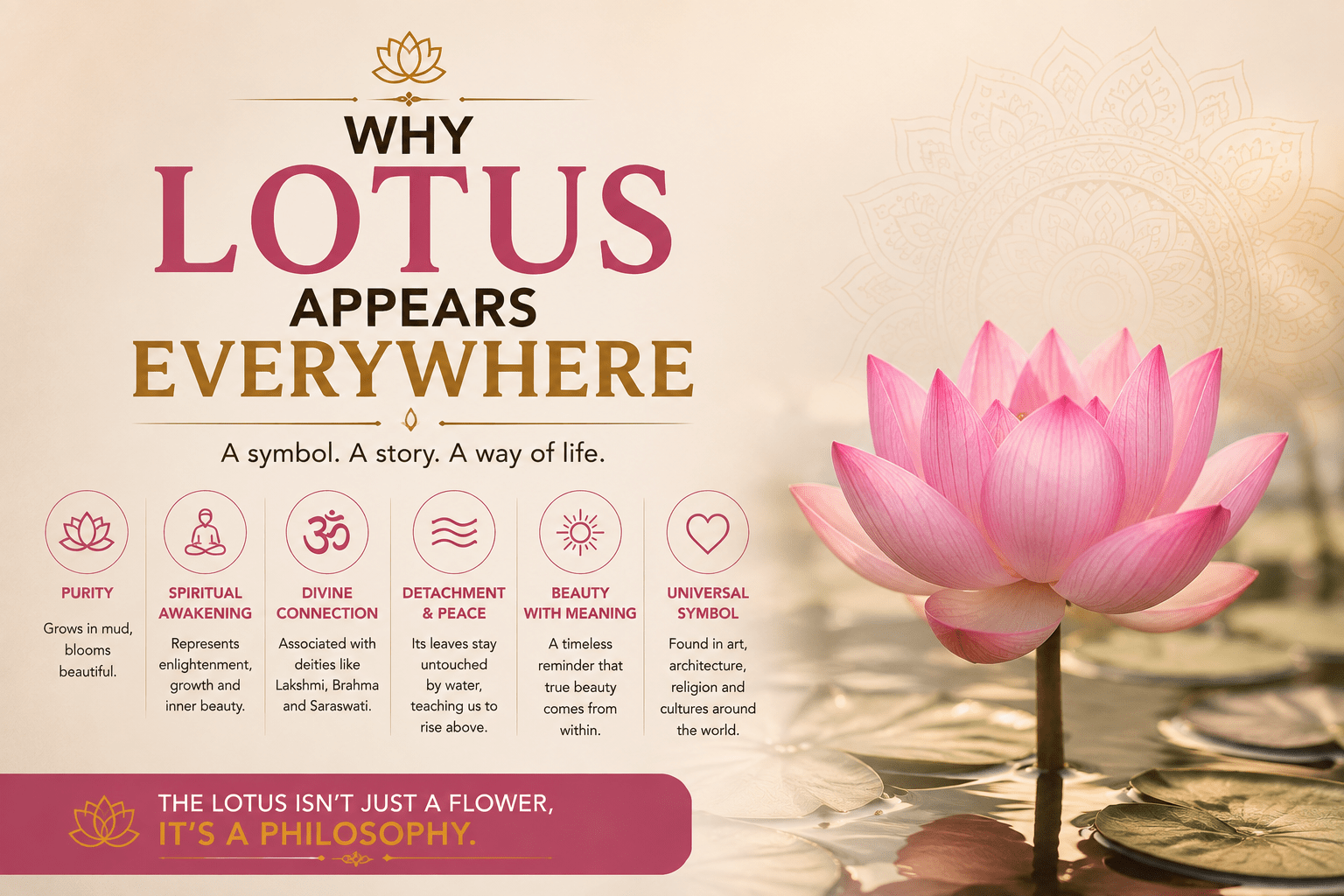
Why Does the Lotus Appear Everywhere in Indian Culture?
Look closely at traditional Indian art and you will notice something beautiful. A lotus appears on temple walls. A lotus sits beneath the feet of deities. A lotus decorates ceilings, pillars and doorways. It appears in paintings, sculptures, jewellery, textiles and traditional architecture. It is offered during worship and frequently appears in depictions of Hindu deities.
But why?
Why does the lotus appear everywhere?
The answer is much deeper than simply saying that it is a beautiful flower. For thousands of years, the lotus has developed powerful associations with purity, beauty, spiritual growth, prosperity, divine presence and detachment across Indian religious and cultural traditions. Its natural life cycle makes it an especially powerful metaphor. The lotus grows in muddy water, rises above the surface and opens into a beautiful flower.
That simple transformation became a profound symbol:
Rise above your surroundings without losing your roots.
Let’s explore why the lotus became one of India’s most recognizable sacred symbols.
-
The Lotus Is More Than a Flower
The lotus is a real aquatic plant, but its cultural importance goes far beyond botany. In Indian traditions, natural objects have often been used to express larger philosophical ideas. The lotus is particularly powerful because of the contrast between its environment and appearance. It grows in water and mud. Yet its flower appears remarkably clean and beautiful above the surface.
This naturally lends itself to symbolism associated with:
- purity
- spiritual development
- beauty
- transcendence
- detachment
- renewal
The flower therefore becomes a visual metaphor for human potential.
-
Why Is the Lotus Considered Sacred in Hinduism?
The lotus flower meaning in Hinduism is connected with several important religious and philosophical ideas. It frequently appears in Hindu iconography.
Gods and goddesses may be depicted:
- standing on a lotus
- sitting on a lotus
- holding a lotus
- surrounded by lotus flowers
The flower can symbolize divine beauty and purity. However, there isn’t one single meaning that applies to every lotus appearing in Hindu art. Its significance depends on the deity, story, artwork and architectural context. This is important because online explanations sometimes reduce complex symbolism into a single definition. Traditional symbolism is usually richer than that.
-
The Lotus and Goddess Lakshmi
One of the most famous associations is with Goddess Lakshmi, who is frequently depicted seated or standing upon a lotus. Lakshmi is associated with prosperity, abundance, auspiciousness and beauty. The lotus therefore becomes part of the visual language used to represent her.
In depictions of Lakshmi, lotus flowers can communicate ideas of:
Beauty + abundance + purity + auspiciousness
This is one reason lotus imagery is especially common during festivals and occasions associated with prosperity.
-
The Lotus and Lord Brahma
The lotus also has a major association with Brahma in Hindu mythology. In well-known traditional narratives, Brahma is depicted emerging from a lotus associated with Vishnu. The imagery is deeply symbolicm. The lotus becomes connected with creation. This gives the flower another layer of meaning. It isn’t only about purity. It can also represent the emergence of creation from the cosmic order. This is one reason lotus imagery appears so prominently in Hindu religious art.
-
The Lotus and Goddess Saraswati
The lotus is also associated with Goddess Saraswati, particularly in artistic representations. Saraswati is associated with knowledge, learning, music and wisdom. The lotus in such imagery contributes to the association with purity, refinement and higher knowledge.
Again, the meaning isn’t simply:
“Lotus = one thing.”
Instead, the lotus participates in a larger visual vocabulary used to communicate divine qualities.
-
The Lotus Represents Spiritual Growth
Perhaps the most powerful interpretation of the lotus is its connection with spiritual awakening. Think about its growth. It begins underwater. It rises upward. Eventually, it opens above the surface. This can be understood metaphorically as a journey:
Ignorance → Learning → Awareness → Spiritual growth
The flower therefore becomes a visual representation of transformation. This is one reason the lotus has such enduring appeal. Its symbolism isn’t limited to temples. It can also be interpreted as a lesson for everyday life.
-
The Lotus and Detachment
The lotus is also associated with detachment in Indian philosophical traditions. The flower’s relationship with water provides a powerful metaphor. Its leaves and flowers have remarkable water-repellent properties, allowing water droplets to remain on the surface rather than easily soaking into it. This natural characteristic has contributed to the metaphor of remaining connected to the world without becoming completely attached to it.
In simple terms:
Live in the world, but don’t let the world control your inner self. This idea of detachment is particularly relevant to Indian philosophical thought. The lotus therefore becomes a visual reminder of inner balance.
-
Why Does the Lotus Appear in Hindu Temple Architecture?
Walk into a traditional temple and look upward. You may discover a lotus carved into the ceiling. Look at a pillar. You may find lotus petals around its base or capital. Look at a doorway. You may see floral lotus motifs.
Why?
Because the lotus works exceptionally well as an architectural motif. Its symmetrical form allows artisans to create beautiful radial patterns.
A lotus can be represented as:
- an open flower
- a closed bud
- layered petals
- a circular ceiling design
- a decorative border
- a pedestal
- a sculptural element
This combination of symbolism + geometry + beauty made the lotus particularly useful in traditional architecture.
-
The Lotus as a Temple Ceiling Motif
One of the most spectacular uses of lotus imagery can be found on temple ceilings. A central lotus may spread outward in concentric layers. The design creates a visual focal point. The viewer naturally looks toward the center. Architecturally, this creates rhythm and symmetry. Symbolically, the unfolding petals can suggest expansion and spiritual awakening. This is a perfect example of how Indian temple architecture combines artistic design with symbolic imagery. The lotus isn’t simply carved because it looks attractive. Its form and meaning work together.
-
Lotus as a Symbol of Purity
Perhaps the most commonly discussed meaning of the lotus is purity.
But what makes the symbol so effective?
The answer lies in its natural environment. The lotus grows from muddy surroundings, yet produces a beautiful flower. That contrast makes it an ideal metaphor for maintaining inner purity despite difficult external circumstances.
This idea can be summarized beautifully:
The environment does not have to define the person.
- The lotus rises.
- It blooms.
- And it remains beautiful.
- That simple image has enormous philosophical power.
-
Why Is the Lotus Used in Worship?
Lotus flowers are used in various Hindu worship traditions. Devotees may offer flowers to deities as an expression of respect, devotion and reverence. The lotus is particularly valued because of its established sacred associations. Depending on regional and religious tradition, different flowers may be preferred for different deities and rituals. Therefore, it would be inaccurate to say that lotus is mandatory for every Hindu puja. Instead, its importance comes from its longstanding symbolic and devotional role.
-
The Lotus in Indian Art
The lotus has become one of the defining motifs of Indian art.
You can find lotus imagery in:
- temple sculptures
- paintings
- manuscripts
- textiles
- jewellery
- architecture
- decorative arts
- religious illustrations
- traditional crafts
Why does it work so well?
Because it is simultaneously:
Natural + geometric + symbolic + beautiful
An artist can simplify the flower into a few lines or create hundreds of detailed petals. Either way, people recognize it immediately.
-
The Lotus Is Also a Symbol of Beauty
The lotus isn’t only about spirituality. It also represents beauty. Its symmetrical petals and graceful form have inspired Indian artists for generations. This is particularly important in religious art. Traditional Indian aesthetics often combine beauty with meaning. A beautiful form can also communicate an idea. The lotus therefore becomes an ideal artistic subject.
-
Lotus and the Idea of Prosperity
The lotus is strongly associated with prosperity and abundance, particularly through its connection with Lakshmi.
This explains why lotus designs frequently appear in:
- festive decorations
- wedding motifs
- rangoli
- jewellery
- textiles
- home décor
- religious artwork
The flower has become associated with auspicious beginnings and positive symbolism. Its presence can communicate more than decoration. It can express a wish for beauty, abundance and good fortune.
- Lotus in Rangoli and Traditional Decoration
The lotus is one of the most popular floral motifs in Indian decorative traditions.
You may see lotus patterns in:
Rangoli
Kolam
Mandala designs
Textiles
Wall art
Floor decorations
Its radial symmetry makes it especially suitable for geometric compositions. A lotus can be drawn from a central point and expanded outward through layers of petals. This makes it particularly effective for decorative designs based on symmetry.
-
Lotus and Meditation
Lotus imagery also appears in discussions of meditation and yoga. The familiar Padmasana, or lotus posture, uses the flower as its name and visual inspiration. The posture is traditionally associated with meditation. The lotus therefore becomes connected not only with religious art but also with the idea of stillness and contemplation. The symbolism is interesting: The flower rises from water but remains still above it. Similarly, meditation seeks a state of inner steadiness despite the movement of everyday life.
-
Why Do So Many Deities Sit on Lotus Flowers?
The lotus can act almost like a symbolic pedestal. When a deity is shown seated or standing on a lotus, the flower visually separates the divine figure from the ordinary ground. It creates an elevated sacred space.
The lotus can therefore communicate:
Purity → Divinity → Beauty → Transcendence
This is one reason the flower appears repeatedly in Hindu iconography. It isn’t merely an accessory. It helps communicate the nature of the figure being represented.
-
The Lotus Is a Symbol of Transformation
Perhaps the most universal lesson of the lotus is transformation. A flower emerges from an environment that appears unlikely to produce something beautiful.
This makes the lotus a powerful reminder:
- Difficult beginnings don’t determine the final outcome.
- The seed begins beneath the water.
- The stem rises.
- The flower reaches the surface.
- Then it opens.
- That natural process becomes a metaphor for human development.
- We can grow.
- We can learn.
- We can change.
- We can rise above difficult circumstances.
-
Why Does the Lotus Appear “Everywhere”?
Now we can answer the original question.
The lotus appears everywhere because it can communicate many ideas simultaneously.
It can represent:
🌸 Purity
🧘 Spiritual growth
✨ Divine beauty
🙏 Devotion
🌿 Detachment
💰 Prosperity
🌱 Transformation
🎨 Beauty and symmetry
🛕 Sacred architecture
Few natural symbols combine so many layers of meaning.
That’s why the lotus became deeply embedded in Indian visual culture.
- The Lotus Is More Than a Religious Symbol
One of the most fascinating things about the lotus is that its symbolism extends beyond religious practice. It has become part of India’s broader cultural identity.
You can find lotus-inspired forms in:
- architecture
- clothing
- jewellery
- sculpture
- government imagery
- home décor
- traditional crafts
- contemporary design
The flower has survived because its meaning remains relevant.
People continue to understand its basic message:
Rise above. Stay rooted. Bloom.
The Real Reason the Lotus Appears Everywhere
So, why does the lotus appear everywhere in Indian culture?
Because it is one of those rare symbols where nature itself seems to tell a story. It grows in mud but blooms beautifully. It rises from water but isn’t defined by the water. Its petals unfold gradually. Its shape is naturally symmetrical. And its beauty has inspired generations of artists. Over time, Indian traditions gave this natural phenomenon deeper philosophical and spiritual meanings. That is why you see the lotus in temples. You see it beneath deities. You see it on ceilings. You see it in paintings. You see it in worship. You see it in traditional crafts. You see it in homes.
The lotus isn’t everywhere simply because it is beautiful.
It is everywhere because it represents an idea.
Stay rooted.
Rise above.
Remain pure.
And keep blooming. 🌸