


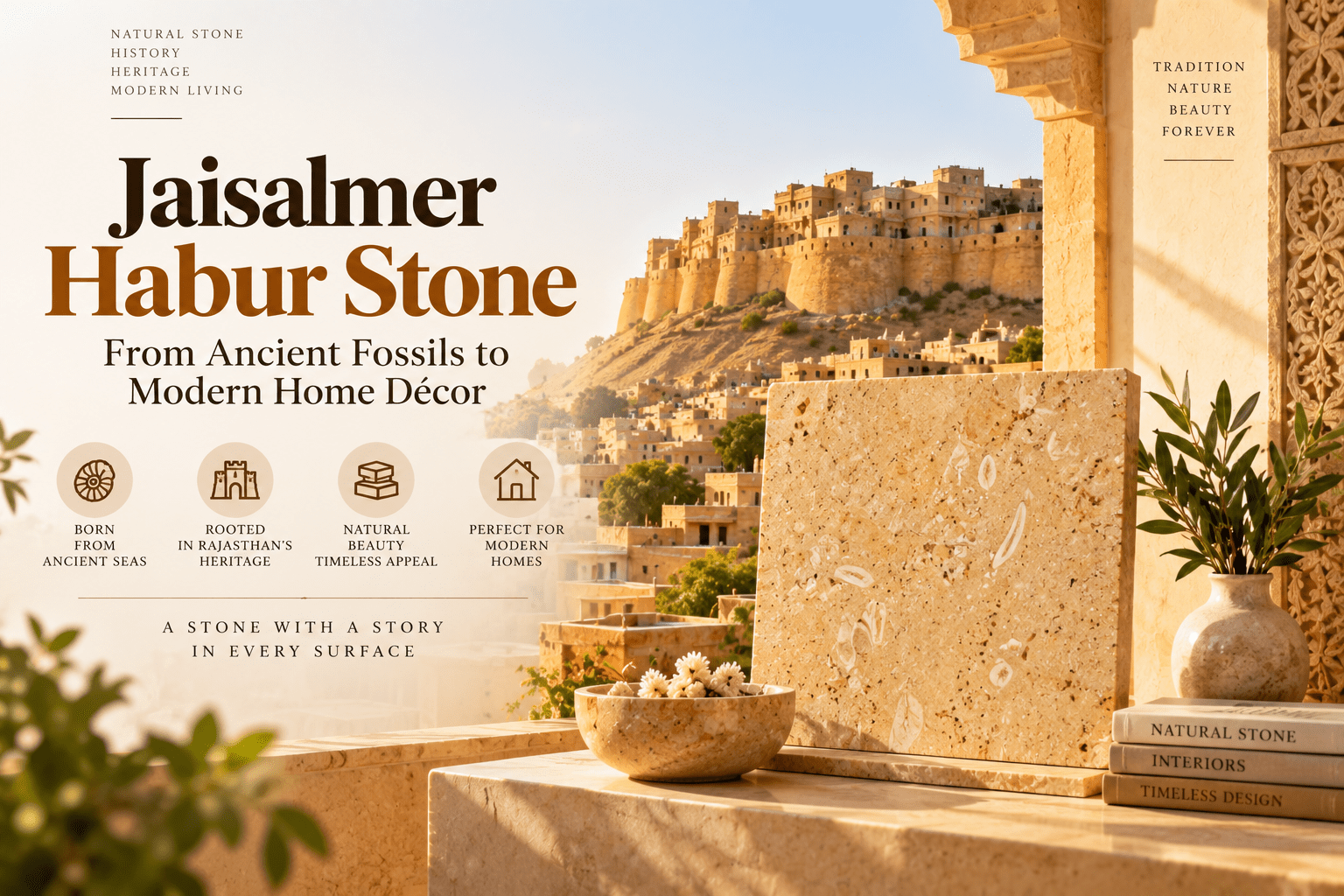
Habur Stone From Jaisalmer: From Ancient Fossils to Modern Home Décor
That is one of the fascinating qualities of Habur Stone from Jaisalmer, a natural stone associated with the Habur area of Rajasthan and commonly marketed as Jaisalmer Fossil Stone. Unlike manufactured decorative materials, natural stone carries its own patterns, colours, textures and surface variations. With Habur Stone, these characteristics are particularly interesting because the material is associated with fossil-rich geological formations in the Jaisalmer region.
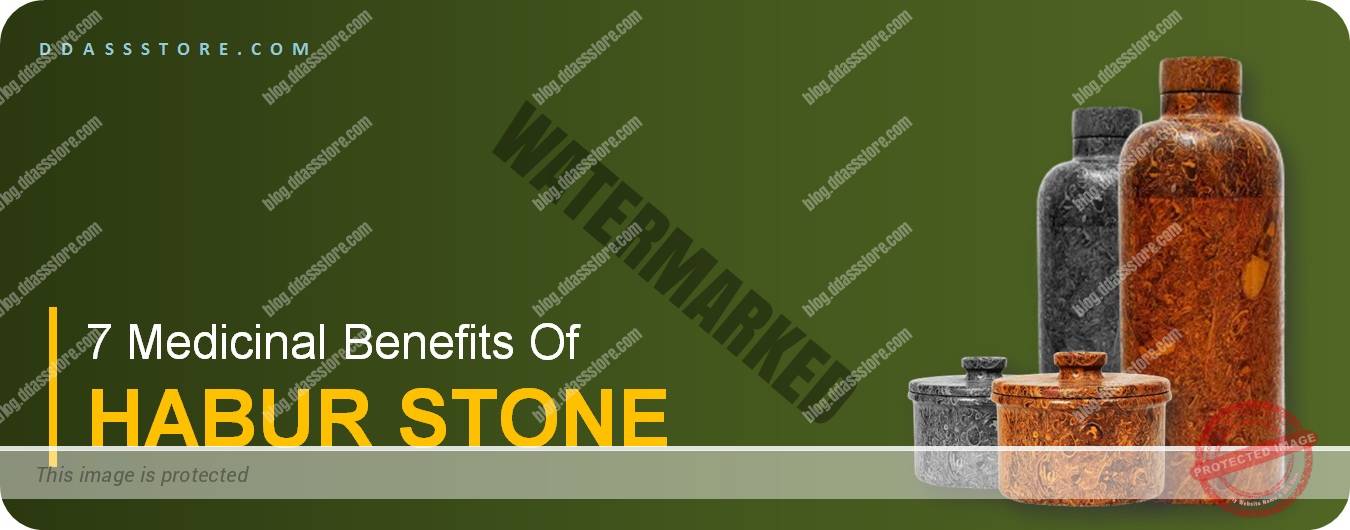
The stone has a distinctive earthy appearance, often featuring reddish-brown and brown tones with darker markings and natural variations. Once shaped by artisans, it can become a bowl, glass, bottle, handi, decorative stone or other distinctive object for the home.
This creates an unusual journey:
Ancient natural formation → Rajasthan stone → Artisan craftsmanship → Modern home décor
That journey is what makes Habur Stone interesting beyond the finished product.
D’DASS currently offers several Habur Stone products, including natural fossil stone pieces, bowls, glasses, a bottle and a covered handi, demonstrating how the same natural material can be interpreted into different forms.
What Is Habur Stone?
Habur Stone is a natural stone associated with the Habur area near Jaisalmer, Rajasthan. It is commonly referred to as Jaisalmer Fossil Stone because of the fossil-related patterns and inclusions that can occur within the material. Unlike synthetic surfaces where patterns can be printed or reproduced, the visual character of natural Habur Stone comes from the material itself. Each piece can therefore have its own combination of colour, markings, veins, pits and other natural characteristics. Habur Stone products as reddish-brown natural stone featuring darker patterns and fossil characteristics. The important point is that its appearance is naturally created.
Why Is It Called Jaisalmer Fossil Stone?
The connection with fossils is one of the primary reasons Habur Stone attracts attention. The Jaisalmer region is well known for its sedimentary geology and fossil-bearing formations. The area’s geological record contains evidence of ancient environments that were significantly different from the landscape we see today. Over geological time, sediments accumulated, compacted and formed layers of rock. Fossil remains and other geological features can become preserved within such formations. This connection with ancient geological history gives fossil-associated stone from the region an unusual appeal. When an artisan transforms such material into a small household object, the finished product becomes more than a functional item. It can also serve as a conversation piece connecting the present-day home with Rajasthan’s geological past.
Nature Creates the Pattern
One of the most interesting characteristics of natural fossil stone is variation. One piece may contain darker spots. Another may show lines or contrasting areas. A third may have a completely different arrangement of markings. This means there is no expectation that every Habur Stone object will look identical.
What Makes Habur Stone Look Different?
Habur Stone has an earthy and organic visual character. The material using brown and reddish-brown tones, along with naturally occurring darker markings and variations. This makes it visually different from highly uniform decorative materials. Its beauty comes from its individuality.
Depending on the particular piece, you may notice:
- Brown and reddish tones
- Dark fossil-like markings
- Natural lines
- Uneven patterns
- Subtle tonal changes
- Small pits or fissures
- Natural surface character
- Variations in colour and texture
These characteristics are not necessarily imperfections. They are part of the natural material and contribute to the individuality of the finished object.
Why Every Habur Stone Piece Can Look Different?
Natural stone does not come from a factory mould. Its geological formation influences its colour, density, pattern and inclusions. Once the stone is extracted and selected, artisans have to work with these characteristics rather than completely controlling them.
Natural Variation Is Part of the Material
This is one of the biggest differences between natural stone and synthetic decorative surfaces. With a printed pattern, repetition and consistency can be controlled. With natural stone, variation is part of the identity. For many homeowners and décor enthusiasts, that individuality is exactly what makes natural stone attractive.
From Raw Stone to a Finished Object
A natural stone deposit is not immediately ready to become a bowl, glass or decorative object. It first needs to be selected, cut, shaped and finished. While the exact manufacturing process can vary depending on the product, the transformation generally involves several stages.
1. Selecting the Material
Suitable stone is selected based on factors such as colour, structure, thickness and the intended product. The natural markings can also influence how the stone is used.
2. Cutting and Shaping
The stone is carefully shaped according to the requirements of the final object. A bowl requires a different form from a bottle, glass or covered handi.
3. Smoothing the Surface
The surface is refined to achieve the required finish while retaining the natural character of the stone.
4. Forming the Final Object
Depending on the design, Habur Stone can be transformed into a bowl, glass, bottle, handi, decorative piece or other home accessory.
5. Finishing
The finished object receives the appropriate surface treatment and detailing so its natural appearance can be appreciated. This transformation represents the meeting point between natural geology and human craftsmanship.
Why Habur Stone Is Interesting as a Craft Material
Habur Stone brings together several qualities that make it distinctive as a décor material.
Natural History
Its visual characteristics are connected to geological processes that took place over extremely long periods.
Visual Individuality
Natural markings mean that every finished object can have its own appearance.
Craft Potential
The stone can be shaped into both functional and decorative objects.
Regional Connection
Its association with the Habur area and Jaisalmer gives it a strong connection with Rajasthan. Together, these qualities make Habur Stone particularly interesting for people who appreciate objects that have a story behind them.
The Connection Between Rajasthan and Natural Stone
Rajasthan has a long and significant relationship with natural stone. The state is widely known for its architecture, monuments, temples, forts, decorative stonework and traditional craftsmanship. Jaisalmer itself is internationally recognized for its distinctive golden-yellow sandstone, which is prominently used throughout the historic city. Habur Stone represents a different aspect of Rajasthan’s relationship with natural materials. Instead of being used only for large architectural structures, stone can be transformed into smaller objects designed for contemporary homes. A Habur Stone bowl on a dining table, a stone glass displayed on a shelf, or a decorative fossil stone object placed in a living room can bring a subtle connection to Rajasthan’s natural and craft heritage into modern interiors.
This creates a connection between regional geology, traditional craftsmanship and contemporary home décor.
Habur Stone in Modern Home Décor
Natural materials are often used in interiors to introduce warmth, texture and individuality. Habur Stone can work particularly well in spaces where homeowners want to introduce an earthy or handcrafted element. A fossil stone bowl can be used as a decorative centerpiece. A Habur Stone glass can become part of a traditional-inspired table setting. A bottle or covered handi can be displayed as an accent piece. A natural fossil stone object can also be paired with other materials such as wood, brass, copper, ceramics or textiles. The contrast between natural stone and warm materials can create a balanced traditional-meets-modern aesthetic. Because the stone already has visual character, it does not necessarily need elaborate decoration around it.
Habur Stone Is More Than a Decorative Pattern
One of the easiest mistakes is to look at a fossil stone object and see only its surface markings. But those markings are part of the material’s identity. A fossil-related appearance is not simply decoration painted on top. Natural variations are what give the stone its visual character. This changes the way the object can be appreciated.
Stone interesting Habur Stone characteristics.
- Every piece can be visually unique.
Natural patterns mean that no two pieces necessarily look exactly alike. - It brings an earthy aesthetic.
The brown and reddish tones can complement wooden furniture and traditional interiors. - It has a connection to Rajasthan.
The material is associated with the Jaisalmer region and the state’s broader tradition of natural stone craftsmanship. - It can be both functional and decorative.
Depending on the design, Habur Stone can become a bowl, glass, bottle, handi or decorative object.
The Story Behind Every Piece
Habur Stone represents an interesting intersection of geology, Rajasthan’s natural heritage, craftsmanship and modern design.
Naturally formed stone associated with the geological landscape around Jaisalmer can eventually become an object placed on a dining table, displayed on a shelf or incorporated into a traditional-inspired interior. That transformation is what makes natural stone décor so fascinating. The finished object may be small, but the story behind its material is much older. From ancient geological formations to the hands of artisans, and finally to a contemporary home, Habur Stone represents a journey through time. For those who appreciate natural materials, handcrafted products and meaningful décor, a Jaisalmer Fossil Stone object can be more than just another accessory. It can be a small reminder that nature does not always create perfect uniformity. Sometimes, the irregularities, markings and differences are exactly what make an object beautiful.
From the ancient landscape of Rajasthan to modern homes, Habur Stone brings together natural history and contemporary craftsmanship in one distinctive material.