




Secret Meanings Behind Temple Carvings: What Do Hindu Temple Sculptures Really Represent?
Walk around an ancient Hindu temple and you will notice something remarkable. The walls are rarely plain. Stone pillars are covered with intricate figures. Doorways feature flowers and geometric patterns. Elephants appear beneath architectural elements. Mythical creatures guard entrances. Deities, dancers, musicians, animals, plants and celestial figures seem to emerge from the stone. At first glance, these may look like beautiful decorations. But traditional Hindu temple carvings often communicate much more than decoration. They can tell stories, represent philosophical ideas, express devotion, symbolize nature and communicate concepts found in Hindu religious traditions. This raises an intriguing question:
What do the carvings on Hindu temples actually mean?
There isn’t one universal meaning for every sculpture. Symbolism varies according to region, temple tradition, deity, historical period and architectural school. However, many recurring motifs have rich cultural and religious associations.
Let’s decode some of them.
-
Temple Carvings Were More Than Decoration
Before books were widely accessible, temples could serve as important places for transmitting stories and cultural knowledge. Sculptures could depict scenes from sacred narratives, divine figures, musicians, dancers, animals and symbolic motifs. A temple could therefore function almost like a three-dimensional visual library. A person walking through the complex might encounter stories and symbols without reading a single word. This is one reason Indian temple carvings are so valuable today. They provide visual evidence of the beliefs, artistic traditions and social world of the communities that created them.
-
The Lotus: Purity and Spiritual Awakening
The lotus is one of the most recognizable symbols in Indian art. It frequently appears in temple architecture, sculpture, paintings and religious iconography. The lotus grows from muddy water but rises above the surface with an unsoiled flower. Because of this distinctive natural characteristic, it has long been associated with ideas such as purity, beauty, spiritual growth and transcendence in Indian traditions.
In temple carvings, lotus motifs can appear on:
- ceilings
- pillars
- door frames
- pedestals
- architectural borders
- decorative panels
Its presence reminds us that something beautiful can emerge from difficult surroundings. The lotus is therefore much more than an ornamental flower.
-
Elephants: Strength, Wisdom and Auspiciousness
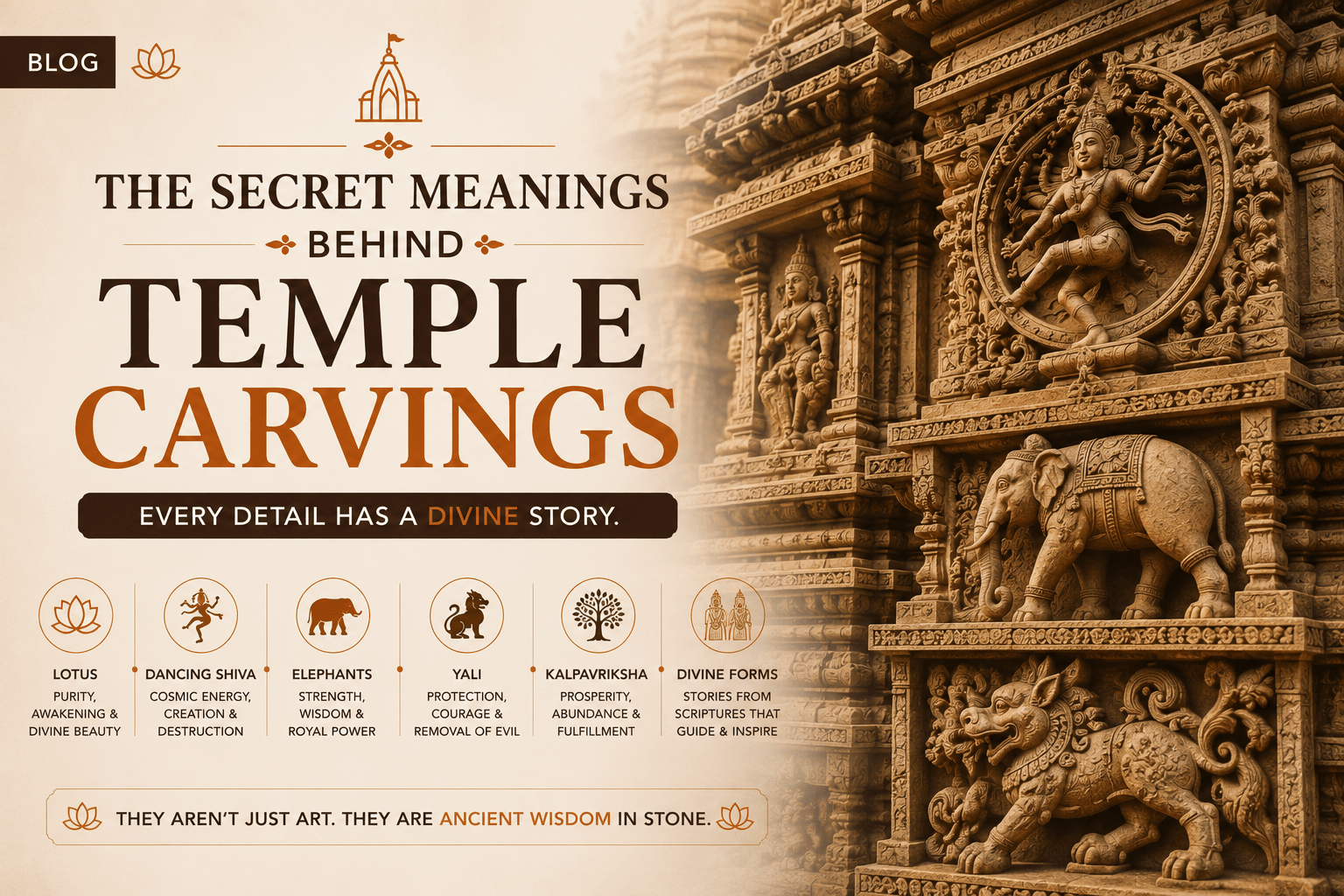
Look closely at traditional temple architecture and you may find elephants supporting pillars, appearing in processions or decorating architectural panels. The elephant has strong cultural and religious associations in India. It can represent strength, stability, wisdom and royal power. Elephants are also closely connected with Ganesha, one of the most widely worshipped Hindu deities. In architectural contexts, elephant motifs can additionally communicate the idea of strength supporting the structure. Their massive physical presence makes them particularly appropriate as symbols of stability. So when you see an elephant carved into a temple, it may be communicating far more than an appreciation for the animal itself.
-
The Dancing Shiva: The Universe in Motion
One of the most famous images in Hindu art is Nataraja, the dancing form of Shiva. The dynamic figure represents Shiva performing the cosmic dance. The symbolism associated with Nataraja is complex and varies across interpretations, but the image is broadly connected with ideas of creation, preservation, transformation and destruction. The dance represents movement. Nothing in the universe remains permanently static. Stars form and disappear. Seasons change. Life begins, develops and ends. The dancing Shiva captures this idea through movement expressed in stone. This is one of the clearest examples of how temple sculptures can communicate philosophical ideas through visual form.
-
Mythical Creatures as Guardians
Not everything carved on a temple represents an ordinary animal. Traditional Indian temple architecture includes numerous mythical creatures. One important category is the yali, a composite mythical creature often associated particularly with South Indian temple architecture. Yalis can appear powerful, lion-like or fantastical, depending on the artistic tradition. They are often found around pillars and architectural elements. Their placement can contribute to the protective and majestic character of a temple. Such creatures demonstrate an important characteristic of Hindu temple art. The boundary between the natural, supernatural and symbolic worlds can be represented through imaginative forms.
-
Deities Tell Stories
Perhaps the most obvious temple carvings are representations of deities. But even these aren’t simply portraits. Traditional Hindu iconography uses specific visual characteristics to communicate identity and attributes.
A deity may be represented with:
- particular weapons
- specific hand gestures
- distinctive ornaments
- symbolic vehicles
- multiple arms
- characteristic poses
- associated animals
- accompanying figures
These details allow devotees and knowledgeable observers to understand who is being represented and what qualities the image communicates. A sculpture therefore becomes a visual language.
-
Animals and Nature Have Their Own Symbolism
Temple walls frequently contain animals, birds, flowers, trees and other elements of the natural world. Peacocks, lions, elephants, horses, serpents and mythical animals appear in different temple traditions. Nature itself is deeply embedded in Indian religious and artistic traditions. These representations can have multiple meanings depending on context. For example, a serpent can be associated with different deities and narratives, while a peacock can have associations with particular deities and stories. Therefore, it is important not to assign one fixed meaning to every animal appearing on a temple.
Context matters.
-
The Tree of Life and Kalpavriksha
Another recurring motif in Indian art is the Kalpavriksha, often understood as a wish-fulfilling or divine tree in Hindu traditions. Trees have powerful symbolic associations across Indian culture.
They can represent:
- life
- fertility
- abundance
- continuity
- shelter
- prosperity
- connection between different realms
A tree extending upward can also visually express growth and connection between earth and sky. When tree motifs appear among temple carvings, they contribute to a larger visual language connecting architecture with the natural world.
-
Guardians at the Entrance
Have you ever noticed imposing figures near the entrance of a temple?
These may represent dvarapalas, or doorway guardians. Their role is closely associated with protecting or marking the threshold of sacred space.
Their presence reinforces an important architectural concept:
The entrance is a transition. You are moving from one environment into another. The guardians visually emphasize that you are approaching a more sacred area. This is one reason temple architecture often uses powerful imagery around entrances.
The architecture itself tells the visitor:
You are crossing a threshold.
-
Mythological Stories Carved in Stone
Many temples contain narrative panels depicting stories connected with Hindu traditions. Episodes associated with the Ramayana, Mahabharata, Puranic traditions and the lives or exploits of deities may appear in different temple complexes. These carvings transform walls into storytelling surfaces. Imagine living centuries ago and walking through a temple filled with scenes from familiar stories. The sculptures could reinforce stories that had been passed down through generations. This makes temple architecture an important medium of cultural memory.
-
Why Are There Dancers and Musicians
Temple carvings don’t always depict gods and mythological creatures. You may also find dancers, musicians and performers. These figures reflect the importance of music and dance within Indian cultural and religious traditions. Classical Indian dance traditions have historically maintained connections with temple culture in several regions. Musical instruments depicted in sculptures can also provide valuable information about historical artistic traditions. The presence of dancers and musicians reminds us that temples were not isolated religious structures. They could be vibrant centers of cultural life.
-
Geometric Patterns Have Meaning Too
Not every important carving is figurative. Temples also contain intricate geometric patterns, repeating borders, floral designs and symmetrical compositions. These patterns demonstrate the importance of proportion, repetition and geometry in traditional Indian architecture. Some architectural traditions use sophisticated geometric planning systems. Patterns can create rhythm across pillars, walls and ceilings. A modern viewer might see decoration. The original artisan may have been working within a highly structured visual system. This is why sacred geometry in Hindu temples is an interesting area of study.
-
The Ceiling Can Be Just as Important as the Walls
One of the most spectacular details in many traditional temples is found overhead. Look up. Temple ceilings can contain elaborate lotus forms, concentric geometric patterns and celestial imagery. The ceiling is not merely structural. It can create a visual center above the worshipper. A carved lotus spreading outward from the center of a ceiling can create the impression of an unfolding sacred form. This demonstrates how traditional Hindu temple architecture considers the entire environment — walls, floor, ceiling, entrance and central shrine — as part of a unified design.
-
Why Are Some Temple Carvings So Detailed?
The extraordinary detail found in ancient temples reflects the skill of traditional artisans. Stone carving requires patience, precision and knowledge of material. Different regions developed distinctive techniques and artistic styles. Some temples were constructed and expanded over long periods, sometimes involving generations of craftsmen. The result is architecture where the building itself becomes a record of craftsmanship. Every pillar, figure and border can demonstrate the artistic vocabulary of its period. This is why temple carvings should also be studied as works of art and architecture, not only as religious symbols.
-
Not Every Carving Has One Secret Meaning
This is perhaps the most important thing to remember. Online discussions sometimes suggest that every single temple carving has one hidden scientific or mystical explanation. Reality is more complex. A sculpture can have multiple layers of meaning.
It may be:
- religious
- symbolic
- architectural
- decorative
- narrative
- cultural
- regional
- historical
And its meaning may change depending on where it appears. A lotus on a ceiling isn’t necessarily communicating exactly the same thing as a lotus in a deity’s iconography. Context matters. This is why serious study of temple carving meanings requires looking at the entire temple, its traditions and historical context.
-
The Temple as a Visual Language
Perhaps the best way to understand temple carvings is to think of them as a visual language.
The temple speaks through:
🪷 Lotus — purity and spiritual symbolism
🐘 Elephants — strength, stability and auspicious associations
🦁 Mythical creatures — protection and imagination
🕉️ Deities — divine narratives and attributes
🌳 Trees — life, abundance and continuity
💃 Dancers — cultural and artistic traditions
🎵 Musicians — devotional and performing arts
🛡️ Guardians — protection and sacred thresholds
📖 Narrative scenes — stories and cultural memory
🔷 Geometric patterns — order, proportion and visual rhythm
But these should be understood as general associations, not rigid translations. The Stone Was Meant to Speak
So, what are the secret meanings behind temple carvings?
The real secret may be that there isn’t just one secret.
- A temple can communicate on many levels simultaneously.
- A flower can be beautiful.
- An elephant can represent strength.
- A deity can tell a story.
- A guardian can mark a threshold.
- A geometric pattern can establish rhythm.
- A dancing figure can express movement.
- And an entire temple can transform these individual elements into one extraordinary visual experience.
- The next time you visit an ancient Hindu temple, don’t simply look at the carvings as decoration.
- Look closer.
**They aren’t just art carved in stone.
They are stories, symbols and traditions carved for generations to discover.** 🛕🪷