




Why Face East During Puja? Understanding the Tradition
Have you ever noticed that many traditional Indian homes carefully consider the direction of the pooja mandir?
The placement of a home temple is often not treated as just an interior-design decision. Traditionally, factors such as direction, cleanliness, natural light and the overall atmosphere of the space have been considered important. Among the different directions, East holds a particularly important place in Hindu worship traditions and Vastu Shastra.
This leads to a simple question:
Why face East during puja?
The answer is rooted in a combination of traditional symbolism, Vastu principles, the significance of the rising Sun and the idea of beginning the day with clarity and positive intention. However, it is important to distinguish traditional beliefs from scientifically established facts. Vastu is a traditional architectural and spatial system, while claims about invisible energies or guaranteed outcomes should not be presented as scientific conclusions.
So, what makes East special?
Let’s explore.
-
East Is the Direction of the Rising Sun
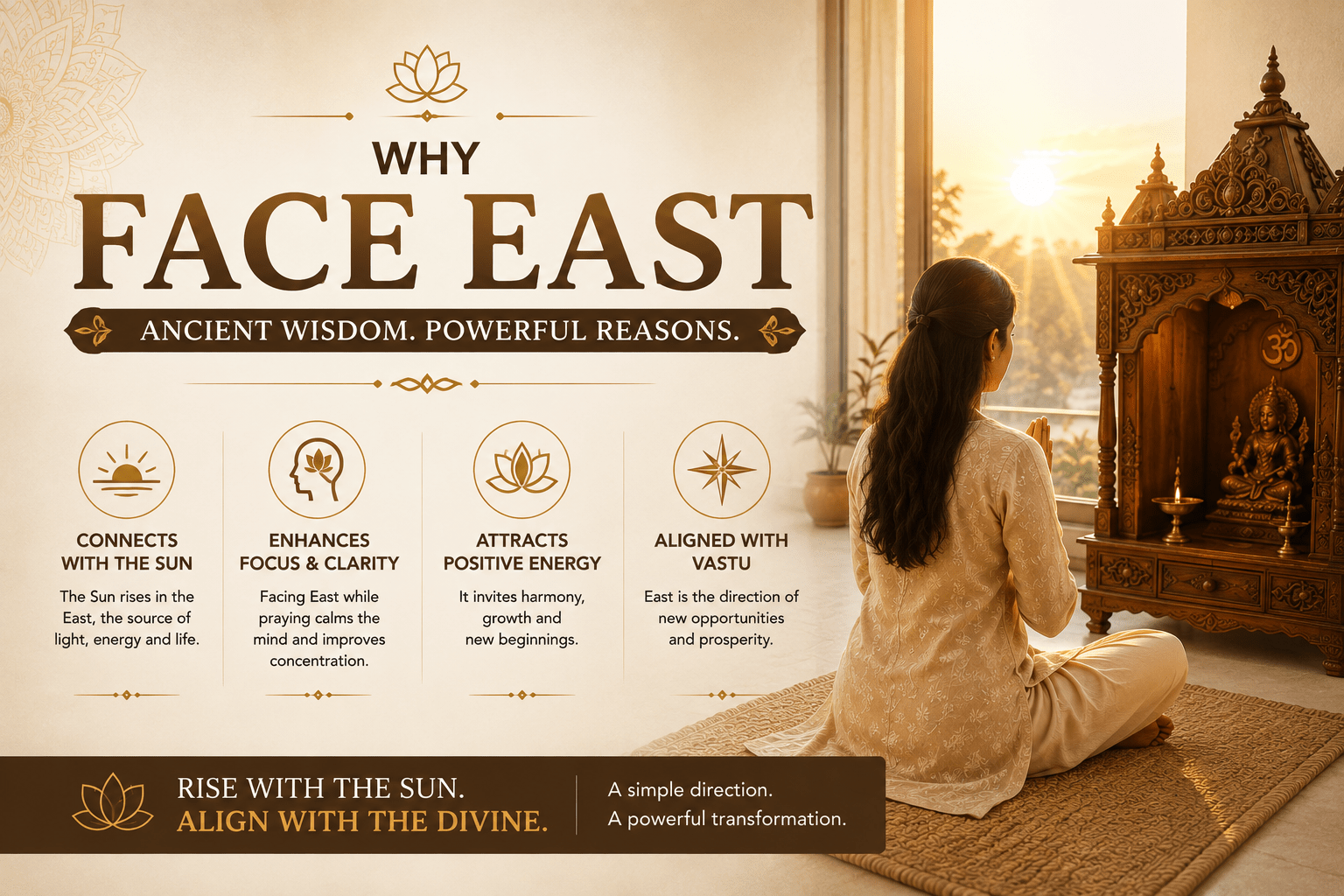
The most obvious reason for the traditional importance of East is the Sunrise. Every morning, the Sun appears in the eastern sky.
Across civilizations, sunrise has represented:
- Light
- Renewal
- New beginnings
- Life
- Awareness
- Hope
Indian traditions developed a particularly strong cultural relationship with the Sun. The morning is often considered an appropriate time for prayer, meditation and spiritual practice. Therefore, facing East while praying naturally connects the worshipper with the symbolism of the rising Sun and a new beginning.
-
The Symbolism of Light Light has enormous importance in Hindu worship. A diya is lit during puja. Camphor may be offered during aarti.
Sunlight enters homes in the morning. The flame itself is frequently used as a metaphor for knowledge and the removal of darkness. The East, being associated with sunrise, fits naturally into this symbolic framework. So when someone faces East during prayer, the traditional interpretation can be understood as:
Turning toward light.
It is a symbolic rather than a scientifically measurable effect.
-
East and New Beginnings
Every sunrise represents a fresh beginning. This makes East particularly suitable for practices intended to establish a positive mindset at the beginning of the day.
Morning prayer while facing East can become a simple daily ritual:
Wake up → Cleanse → Sit before the mandir → Face East → Pray → Begin the day
The direction itself doesn’t guarantee success. Instead, the ritual provides a consistent psychological cue:
The day is beginning. That consistency can make a spiritual routine easier to maintain.
-
What Does Vastu Say About Facing East?
Vastu Shastra is a traditional Indian system concerned with the arrangement and orientation of spaces. In many Vastu traditions, East is considered an auspicious direction because of its association with the rising Sun.
For a home temple, different Vastu traditions provide recommendations concerning:
- Location of the mandir
- Direction of the deity
- Direction faced by the worshipper
- Placement of lamps
- Cleanliness
- Height and design of the altar
These recommendations can vary according to the specific Vastu tradition or school being followed. Therefore, there isn’t one universal rule that applies identically to every Hindu home.
-
Why Is Facing East Traditionally Considered Auspicious?
The idea is fundamentally symbolic. East represents the beginning of the day. The Sun rises there. Light emerges from darkness. Therefore, facing East during prayer can represent an orientation toward:
Light → Knowledge → Awareness → Renewal
This symbolic chain explains why East has remained important in many Indian spiritual practices. It isn’t necessary to claim that a person receives a special physical energy simply by facing East. The cultural meaning is already powerful.
-
Facing East During Morning Prayer
The association becomes especially intuitive during morning worship. Imagine sitting before your home mandir just after sunrise. Natural light gradually fills the room. The diya is lit. Incense may be offered. The surroundings are quiet. Facing East connects the ritual with the beginning of the day. This can create a peaceful transition from sleep to activity. The result is not necessarily supernatural. It can simply be a structured morning ritual that encourages calmness and intention.
-
The Sun’s Importance in Indian Tradition
The Sun occupies a significant position in Indian religious and philosophical traditions. Surya, the Sun deity, is traditionally associated with light, vitality and life. Practices such as Surya Namaskar and Surya Arghya reflect the broader cultural importance of the Sun. The Sun is also essential in practical terms: sunlight regulates the natural environment and supports life on Earth. This combination of observable natural importance and religious symbolism helped make the East a meaningful direction.
-
Why Is the East Associated With Knowledge?
Light and knowledge have been closely connected in Indian philosophical imagery. Darkness can symbolize ignorance. Light can symbolize awareness. This symbolism appears repeatedly in Indian spiritual traditions.
The familiar idea of moving:
From darkness to light
is therefore more than a physical description. It becomes a metaphor for learning and spiritual understanding. Facing East during prayer can be interpreted within this larger symbolic framework. The devotee turns toward the direction from which daylight emerges.
-
Does Facing East Improve Concentration?
You may find claims online that facing East automatically improves concentration. That statement is too strong. There is no established scientific evidence that simply orienting your body toward East produces a guaranteed improvement in concentration. However, a consistent prayer setup can certainly help establish a habitual mental state. If you always sit in the same clean, quiet place at the same time of day, your mind can begin associating that environment with prayer and reflection. The benefit may therefore come from the routine and environment, rather than from the compass direction itself.
-
East-Facing Pooja Room in Modern Homes
Modern Indian homes are very different from traditional houses.
Apartments may have:
- Limited space
- Open-plan living rooms
- Wall-mounted mandirs
- Compact prayer corners
- Built-in storage
- Multi-purpose rooms
Because of this, it isn’t always possible to design a perfect East-facing pooja room. That doesn’t mean the home cannot have a meaningful prayer space.
A practical approach is to prioritize:
Cleanliness + quietness + respectful placement + comfortable access + good ventilation
If the layout allows an East-facing arrangement, it can be incorporated according to the family’s preferred tradition. If it doesn’t, there is no reason to turn the placement of a small home mandir into a source of anxiety.
-
Should the Deity Face East or Should the Person Face East?
This is one area where people often become confused. There is a difference between:
The direction the deity faces and the direction the devotee faces while praying. Different traditions and Vastu guidelines may recommend different arrangements.
For example, a particular home may be designed so that the devotee faces East while worshipping. Another traditional arrangement may use a different orientation based on the deity, temple design or local practice. Therefore, avoid treating one arrangement as the only valid Hindu practice. If direction is important to your family, follow the tradition or Vastu system you actually practice.
-
East-Facing Mandir and Natural Light
There is also a practical architectural advantage when an East-facing prayer area receives appropriate morning sunlight.
Morning daylight can make a room feel:
- Brighter
- More welcoming
- Fresh
- Calm
- Naturally illuminated
Natural light can be particularly beautiful around a wooden home temple. The warm morning light falling across carved wood, brass diyas and traditional decorations can create a visually peaceful environment. This is an aesthetic and environmental consideration rather than proof of supernatural effects.
-
Why Morning Prayer Is Traditionally Important
Many Indian households traditionally begin the day with some form of prayer or spiritual practice.
The routine may include:
- Lighting a diya
- Chanting a mantra
- Offering water
- Reading scripture
- Meditation
- Offering flowers
- Performing a short puja
The purpose can vary from family to family. But the underlying idea is similar: Begin the day with intention. Facing East can become part of that ritual because East symbolizes the beginning of a new day.
-
The Psychological Power of Ritual
There is an interesting modern perspective on this tradition. A repeated ritual can help establish a mental transition.
Consider the sequence:
- You enter your prayer area.
- You sit down.
- You face the same direction.
- You light the diya.
- You close your eyes.
- You begin chanting.
After repeated practice, these actions become associated with a particular mental state. The direction becomes part of the ritual architecture. This doesn’t mean East has a scientifically proven special effect on the brain. Rather, consistency itself can make rituals meaningful and easier to maintain.
-
Why the Direction Matters in Traditional Indian Architecture
Traditional Indian architecture often pays attention to orientation. The cardinal directions—North, South, East and West—are not treated as interchangeable in many traditional systems. Different directions are associated with different qualities, deities and functions. East receives special attention because of its connection with the rising Sun. This broader directional framework is one of the defining features of Vastu-based spatial planning. The home temple therefore becomes part of a larger architectural philosophy.
-
What If Your Mandir Cannot Face East?
This is important for modern homeowners. Don’t redesign your entire home simply because your existing mandir doesn’t face East. A home temple should ultimately be a place where you can pray peacefully and consistently. If your apartment layout means that you face North, West or another direction, your worship does not become meaningless. Hindu worship has always included diverse regional, sectarian and household traditions. The spiritual value of prayer isn’t determined by a compass alone. If following a particular Vastu tradition matters to you, consult a qualified practitioner who understands your specific home layout rather than relying on generic internet rules.
-
East-Facing Pooja Space: Practical Design Tips
If you are designing a new home temple and want to incorporate an East-facing arrangement, consider the following:
- Choose a clean location
The prayer area should feel distinct from clutter and heavy household activity.
- Use natural light
Where possible, allow gentle morning light into the space.
- Maintain ventilation
Incense and lamps should be used in a properly ventilated environment.
- Keep the mandir organized
Avoid storing unrelated household objects around the shrine.
- Create visual calm
Natural wood, soft lighting and traditional brass accessories can create a serene environment.
- Make it practical
The mandir should be easy for the family to access and maintain.
- Why East Works Beautifully With a Wooden Home Temple
Wooden mandirs have a natural warmth that pairs particularly well with morning light.
Imagine:
Soft sunrise light falling across handcrafted wooden carvings while a brass diya glows inside the mandir.
This combination brings together three elements of traditional Indian aesthetics:
Wood + Brass + Light
It creates a space that feels both traditional and suitable for modern homes.
-
East Is a Symbol, Not a Guarantee
It’s important to understand the distinction. Traditional Vastu may recommend facing East.
That doesn’t mean facing East guarantees:
- Wealth
- Success
- Health
- Career growth
- Family harmony
- Instant positive energy
Such claims go beyond what can reasonably be established. Instead, East should be understood as a traditional orientation associated with sunrise, light, auspiciousness and new beginnings. That interpretation is both culturally meaningful and intellectually honest.
-
The Deeper Meaning of Facing East
Perhaps the most beautiful part of the tradition is its simplicity. Every morning, the Sun rises. A new day begins. And a person sits quietly before the divine. Facing East becomes a symbolic gesture toward that beginning.
It says:
Yesterday is over. Today has begun. Let me begin it with gratitude, clarity and intention.
That is a powerful idea regardless of whether you interpret it religiously, philosophically or simply as a morning habit.
Conclusion: Why Face East During Puja?
So, why face East during puja?
The tradition has several layers.
☀️ The Rising Sun
East is where the Sun rises, making it a natural symbol of light and new beginnings.
🪔 Light and Awareness
Hindu traditions frequently use light as a metaphor for knowledge and spiritual awareness.
🕉️ Vastu Tradition
Vastu Shastra traditionally gives importance to East and incorporates direction into spatial planning.
🙏 Ritual and Respect
Facing a particular direction can become part of a consistent and mindful prayer routine.
🌅 A Fresh Beginning
Morning worship facing East can symbolically connect the start of the day with renewal and positive intention.
But perhaps the most important lesson is this:
Facing East isn’t about chasing luck. It’s about turning toward the light.
Whether you follow Vastu strictly or simply appreciate the symbolism, the idea remains beautiful. Every morning brings another sunrise.
Another opportunity to pause.
Another opportunity to pray.
Another opportunity to begin again.
Face the East.
Welcome the light.
Begin the day with intention.☀️🙏