



Why Some Hindu Temples Have Non-Straight Entrances?
Have you ever entered a traditional Hindu temple and noticed that the path toward the main shrine isn’t always a simple, straight line?In some temples, devotees pass through multiple gateways, courtyards or transitional spaces before reaching the sanctum. The deity may not be immediately visible from the outer entrance. This has led to a popular question:
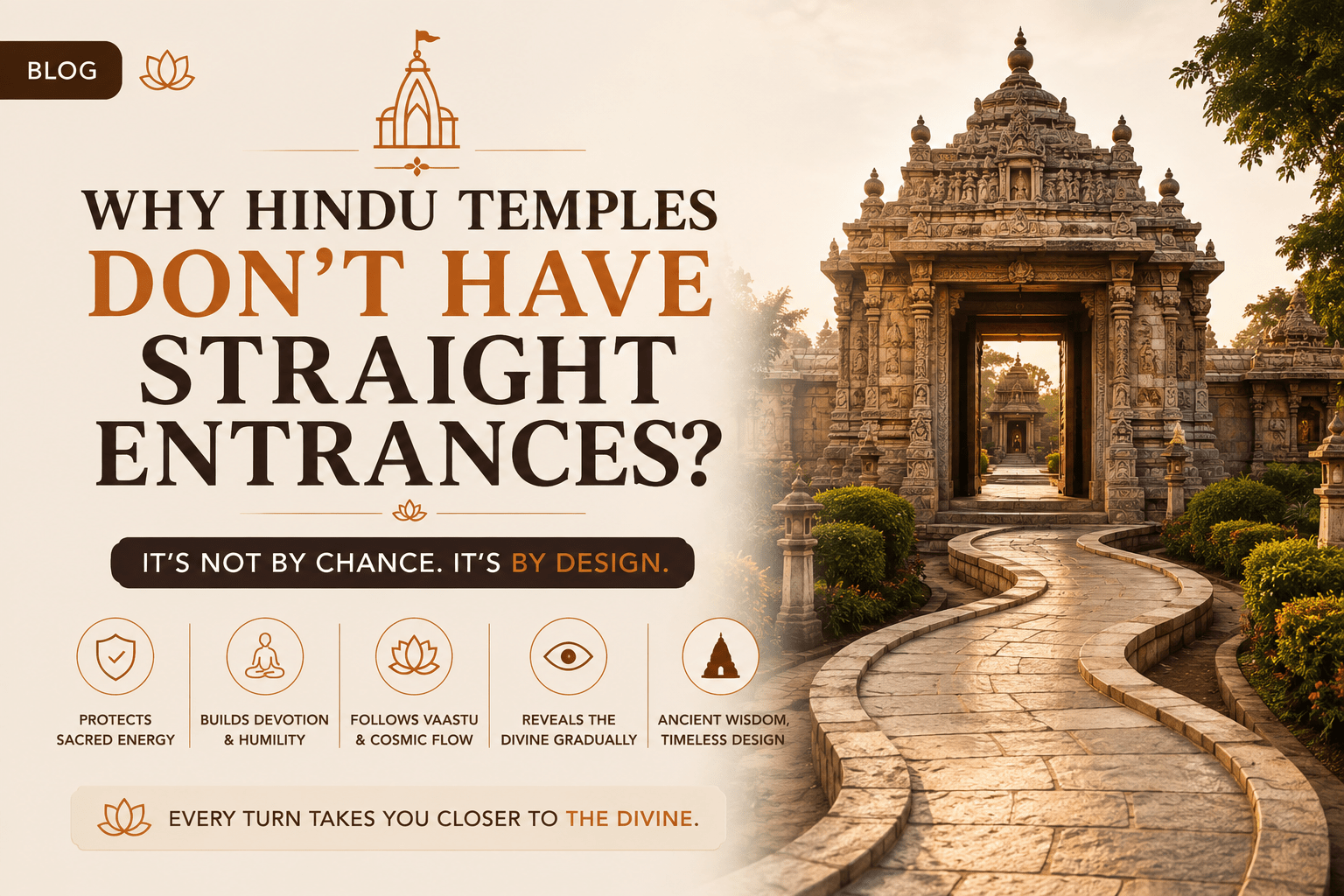
Why do Hindu temples not have straight entrances?
Not all Hindu temples avoid straight entrances. In fact, many traditional temples use strong axial planning, where the entrance, major architectural spaces and sanctum are aligned along a central axis. However, some temples do use indirect approaches, multiple gateways, turns, courtyards or controlled visual access. These arrangements aren’t necessarily designed for one single reason. They can result from a combination of ritual requirements, architectural planning, site conditions, symbolism, security, processional movement and regional temple traditions.
Let’s understand the idea behind this fascinating aspect of Hindu temple architecture.
-
First, Is It True That Hindu Temples Don’t Have Straight Entrances?
This is the most important point. There is no universal rule in Hindu architecture saying that a temple must have a curved or indirect entrance. Many famous Hindu temples are organized around strong geometric axes. In several traditional architectural systems, the movement from the entrance toward the sanctum can be highly structured and symmetrical. So the statement “Hindu temples don’t have straight entrances” should not be treated as a universal architectural fact.
Instead, a better question is:
Why do some Hindu temples use indirect approaches or prevent a direct view of the sanctum from the entrance?
That question reveals much more about temple design.
-
The Temple Is Designed as a Journey
A Hindu temple is not simply a building containing a deity. Traditional temple architecture can be understood as a carefully organized journey through different spaces.
A devotee may move through:
Entrance → Gateway → Courtyard → Mandapa → Inner spaces → Sanctum
Each stage can gradually change the atmosphere. The outside world is open, noisy and active. The deeper one moves into the temple, the more controlled and focused the environment becomes. This makes the physical journey part of the ritual experience. Instead of immediately seeing everything, the devotee gradually approaches the sacred center.
-
Why Isn’t the Deity Always Visible From the Entrance?
One of the most interesting aspects of Hindu temple entrance architecture is controlled visibility. In some temples, the deity is not immediately visible from the outer entrance. This can make the eventual experience of darshan more deliberate. The devotee moves through the temple, crosses architectural thresholds and finally reaches the sanctum. The changing visibility creates a sense of anticipation. It is similar to the difference between seeing something instantly and gradually discovering it. The architecture can therefore influence the emotional experience of worship.
-
The Sanctum Is the Spiritual Center
The central shrine, commonly known as the garbhagriha, occupies a particularly important position in many Hindu temples. The word is commonly translated as “womb chamber”, reflecting the idea of an enclosed, sacred inner space. It is generally more restricted than the outer areas of the temple.
The architecture establishes a hierarchy:
Public → Transitional → Sacred → Most Sacred
This hierarchy is one reason temple movement can feel very different from entering an ordinary building. The deeper spaces are progressively more controlled.
-
Multiple Gateways Create a Sense of Transition
Large temples may contain several gateways or layers of enclosure. South Indian temple complexes, for example, can have multiple prakaras, or enclosed zones, with gateways known as gopurams. A devotee may pass through one enclosure and then another before reaching the central shrine. This creates a series of thresholds. Each threshold represents movement from one space to another. Architecturally, it also allows a temple complex to accommodate large numbers of devotees, ritual activities and processions. Therefore, multiple gateways shouldn’t automatically be interpreted as a method for blocking “negative energy.” Their functions can be architectural, ritual, social and symbolic at the same time.
-
Temple Architecture and Sacred Geometry
Traditional Hindu temple architecture often uses geometry, proportion, orientation and symmetry in sophisticated ways. Architectural traditions such as Vastu Shastra and temple design treat the relationship between space, direction and structure as important. Temple plans may use grids and proportional systems to organize different areas. This can produce strong central axes and carefully positioned spaces. Interestingly, this means that the idea of a “non-straight entrance” cannot simply be explained as a Vastu rule. In many traditional temple plans, axial alignment is actually highly important. The architectural arrangement depends on the specific temple tradition, site and design.
-
The Path Can Encourage Slower Movement
Where an indirect pathway does exist, it can influence how people move. A straight corridor encourages direct movement from point A to point B. A sequence of gateways, courtyards and turns naturally slows the journey. This can be useful in a religious environment. A devotee isn’t necessarily expected to rush toward the sanctum. The movement itself becomes part of the experience.
The idea can be summarized beautifully:
The destination matters, but so does the journey.
This is particularly relevant to temples designed for ritual processions and circumambulation.
-
Circumambulation Is an Important Temple Practice
Many Hindu temples provide spaces for pradakshina, the ritual practice of circumambulating a sacred object or shrine. Devotees may walk around the sanctum in a prescribed direction as part of worship. This means temple circulation isn’t always designed like a modern commercial building where the shortest route between two points is the primary objective. Instead, movement can have ritual meaning.
The architectural layout may deliberately provide spaces for:
- walking
- circumambulation
- gathering
- prayer
- ritual processions
- viewing the deity
- devotional activities
Thus, temple architecture needs to be understood through its ritual function, not only its appearance.
-
Site Conditions Also Influence Temple Entrances
Not every unusual temple entrance has a mystical explanation. Practical factors matter.
Temples have historically been built on a huge variety of sites:
- hills
- riverbanks
- rocky terrain
- existing settlements
- coastal areas
- forested regions
- urban environments
The available land can influence orientation and circulation. A temple may also have been expanded over centuries. An original structure could later be surrounded by additional walls, halls, gateways and buildings. What appears today as a complicated or indirect entrance may therefore be the result of historical development rather than one original design decision.
-
Temple Entrances Can Also Manage Crowds
Large temples can receive thousands or even millions of visitors, particularly during festivals. Multiple entrances, corridors and courtyards can help organize movement.
A controlled approach can:
- distribute crowds
- create queues
- separate ritual and public circulation
- manage access to restricted areas
- accommodate processions
- protect important architectural spaces
This is a practical architectural function that is sometimes overlooked when people discuss the spiritual meaning of temple layouts. Ancient temple designers were dealing with real human movement as well as religious symbolism.
-
Why Do Some Temples Hide the Sanctum From Direct View?
A restricted line of sight can create a powerful experience of revelation. Instead of seeing the deity immediately from outside, the devotee encounters the sacred image after moving deeper into the temple. This can enhance the emotional importance of darshan.
The experience becomes:
Approach → Anticipation → Revelation → Darshan
The architecture participates in creating that sequence. However, this is a symbolic and experiential interpretation, not a universal rule governing every Hindu temple.
-
Is This Because of “Negative Energy”?
You may find explanations online claiming that Hindu temples deliberately avoid straight entrances so that negative energy cannot enter the sanctum. This is a popular modern explanation, but it should be treated carefully. There is no scientific evidence establishing that a temple’s curved pathway physically blocks supernatural negative energy. Similarly, it would be inaccurate to present such claims as established facts of Vastu Shastra or Hindu temple architecture. Traditional beliefs can certainly have spiritual meaning for devotees, but they should be distinguished from documented architectural principles. A stronger explanation looks at the combination of ritual movement, sacred hierarchy, geometry, site conditions and historical development.
-
Temple Architecture Is Different Across India
India does not have one single temple architecture. There are major regional traditions, including:
Nagara Architecture
Commonly associated with northern and central India, with distinctive temple towers and plans.
Dravida Architecture
Associated particularly with southern India, often featuring large temple complexes, enclosure walls and monumental gopurams.
Vesara and Regional Traditions
Various architectural traditions developed through interactions between regional styles and historical periods. Because temple architecture varies so dramatically, there cannot be one universal explanation for every temple entrance. The design of a temple in Tamil Nadu may be very different from one in Odisha, Rajasthan, Karnataka, Kerala or the Himalayan regions.
-
The Entrance Is a Threshold Between Two Worlds
There is, however, a powerful symbolic idea common to many sacred spaces:
An entrance is a threshold. You leave one environment and enter another. In a Hindu temple, this transition can be especially meaningful.
Outside the temple:
Activity. Noise. Movement. Everyday life.
Inside:
Ritual. Reflection. Devotion. Sacred space.
Whether the physical path is perfectly straight or contains several turns, the architectural threshold represents a change in context. The temple asks the devotee to enter with a different state of mind.
-
What Can Modern Homes Learn From Temple Design?
The principles behind traditional temple architecture can also inspire modern pooja room and home temple design. You don’t need to recreate a giant temple complex inside your home. Instead, you can borrow the idea of creating a deliberate transition.
For example:
Living space → Pooja area → Quiet devotional space
A well-designed home mandir can create a visual and psychological separation from the rest of the room.
Lighting, materials, proportions, storage and placement can all contribute to making the area feel intentional.
This is particularly useful for modern apartments where a dedicated pooja room may not be possible.
Conclusion: The Temple Is More Than a Straight Line
So, why do some Hindu temples not have straight entrances?
The answer isn’t simply that Hindu temples were designed to block energy or that every temple deliberately avoids straight entrances.
The reality is much more fascinating. Different temple traditions use different architectural strategies.
Some create strong central axes.
Some use multiple gateways.
Some control the view of the sanctum.
Some incorporate courtyards and circumambulatory paths.
Others have developed organically over centuries because of expansions, geography and changing community needs. The deeper lesson is that temple architecture was designed around experience, not just appearance. Every gateway, threshold, courtyard and pathway can contribute to how a devotee moves through the sacred environment.
And perhaps that gives us a beautiful way to understand the temple:
It isn’t always about reaching the destination quickly.
It is about preparing yourself before you arrive.
Because sometimes, the most meaningful part of the journey isn’t the straightest path.
**Every turn can be a moment to pause.
Every threshold can be a moment to reflect.
And every step can bring you closer to the divine.** 🛕🙏